ASTERO CARBON | RESOURCE RECOVERY
Recover More From Subsurface Flow
Additional Value Pathways Beyond Power
Astero evaluates whether produced fluids, reservoir chemistry, existing infrastructure, and closed-loop operations may support additional value pathways beyond electricity generation.
Depending on site-specific conditions, those pathways may include recovery of dissolved energy molecules, minerals and critical elements, water-resource opportunities, and carbon dioxide management. Each pathway must be validated through fluid analysis, concentration testing, technology review, permitting, infrastructure assessment, and commercial screening.
VALUE HIERARCHY
Power First. Additional Value Where Supported.
Resource recovery begins with the reservoir and operating system
Astero does not begin with an assumption that a site contains commercially recoverable carbon, gas, hydrogen, lithium, or critical minerals. The evaluation begins with reservoir deliverability, produced-fluid volume, heat, pressure, chemistry, reinjection capacity, and infrastructure.
Once the primary power pathway is understood, Astero can evaluate whether additional products or services may improve the project’s total value.
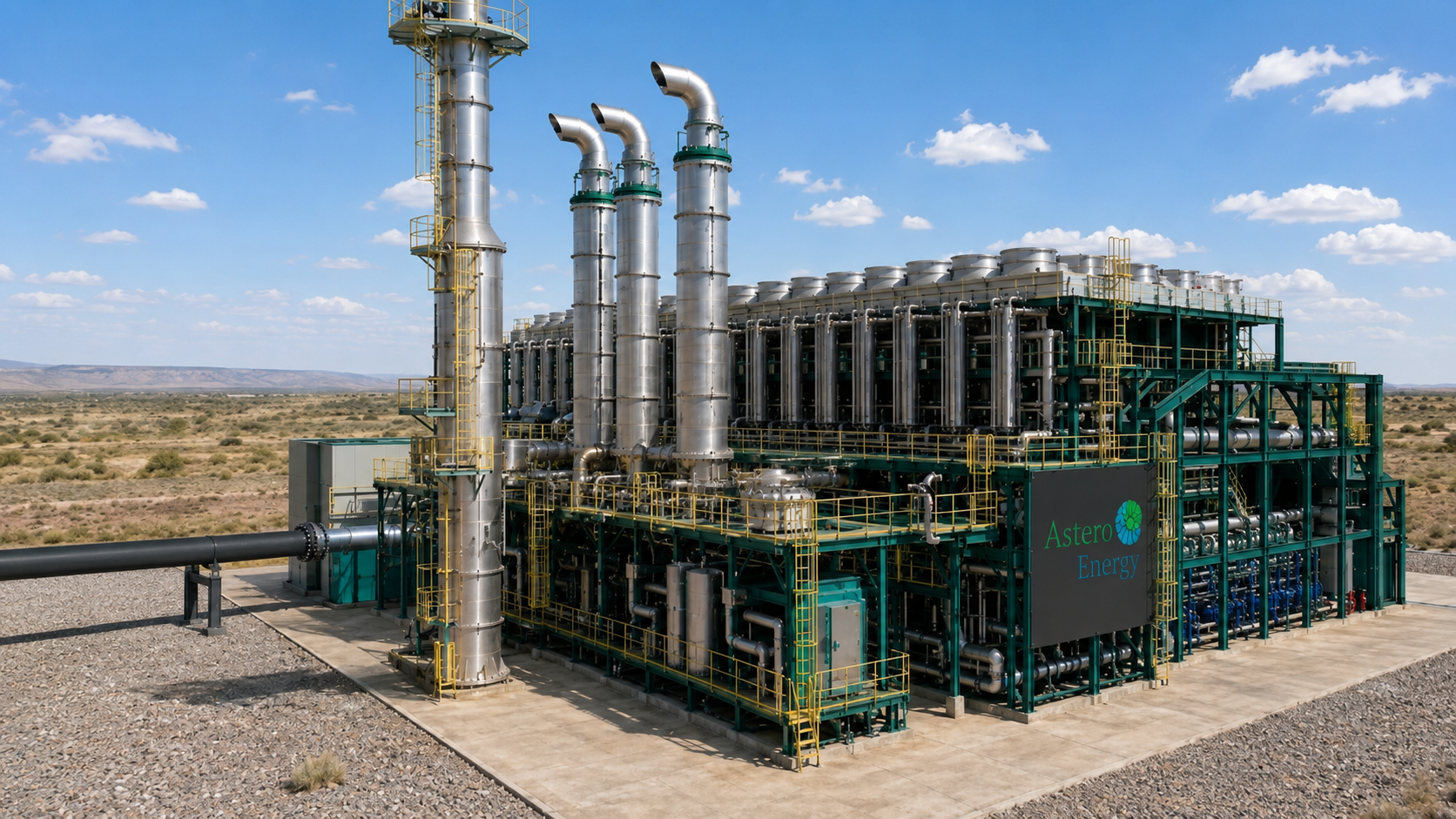
Power Generation
Establish the Primary Pathway
Evaluate thermal, hydraulic, and chemical energy potential before adding secondary recovery systems. Power generation should remain grounded in verified reservoir deliverability and continuous fluid throughput.
Molecular Recovery
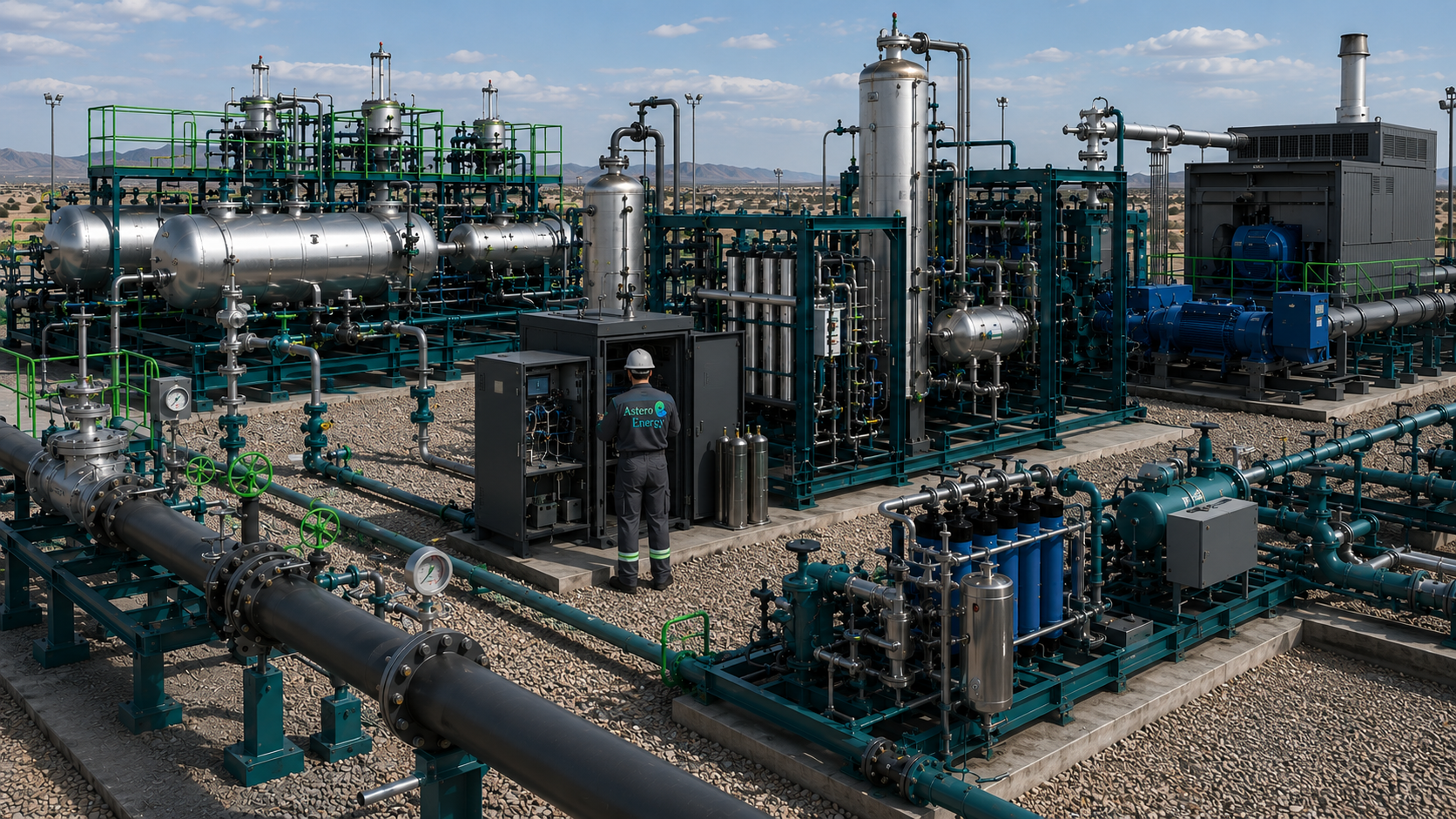
Recover Energy-Bearing Molecules
Assess dissolved or associated natural gas, hydrogen potential, and other energy-bearing molecules where fluid chemistry, concentration, separation technology, and market access support recovery.
Mineral Recovery
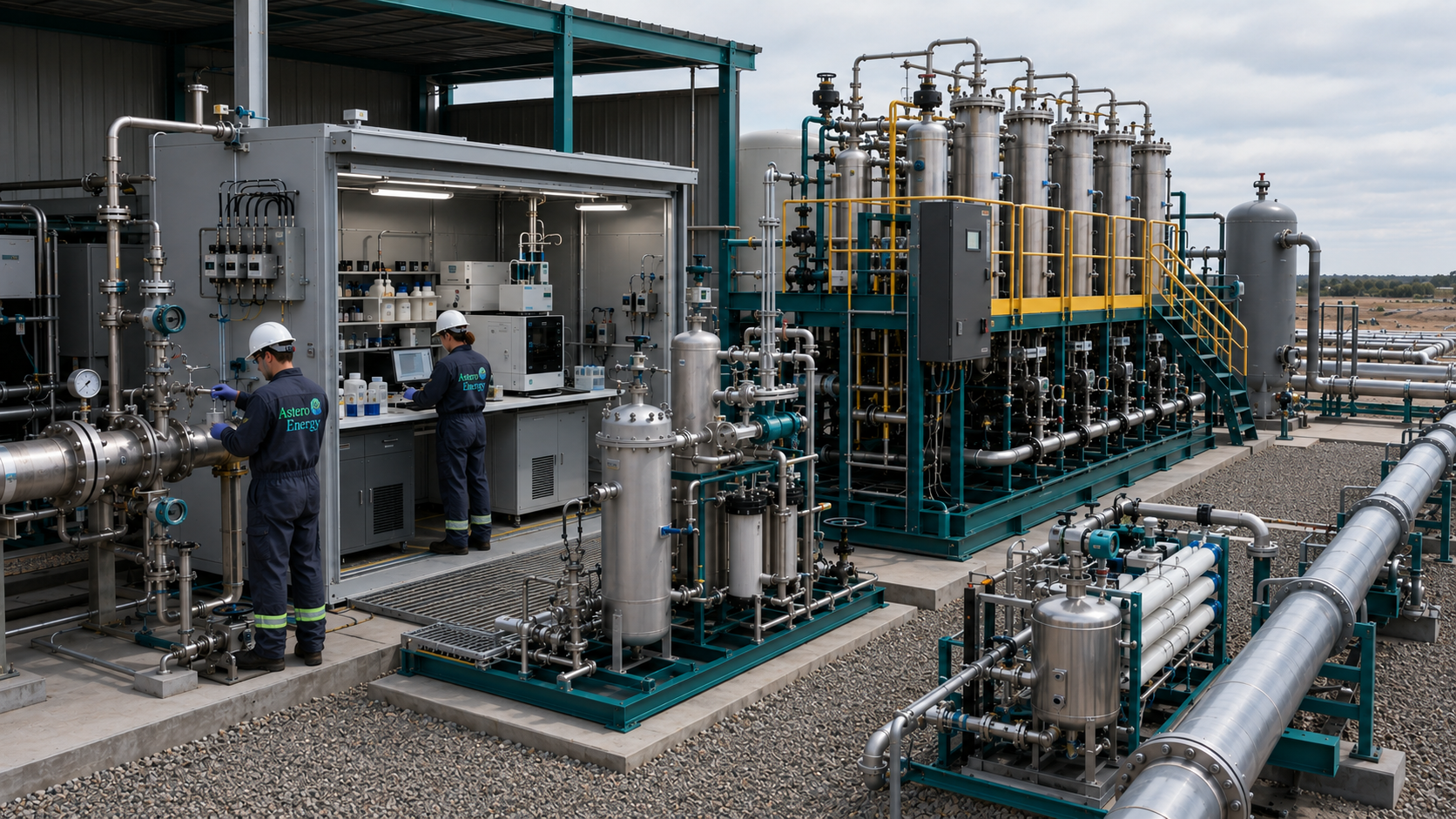
Screen for Valuable Elements
Analyze produced-fluid chemistry for lithium, zinc, rare-earth elements, and other minerals that may justify selective extraction or concentration.
Carbon Pathways
Evaluate Carbon Management
Review carbon dioxide capture, handling, utilization, infusion, transport, or geologic storage only where reservoir conditions, monitoring requirements, infrastructure, regulation, and economics support the pathway.
MOLECULAR RECOVERY
Recover Energy Molecules From Produced Fluids
Dissolved and associated molecules may create an additional energy pathway
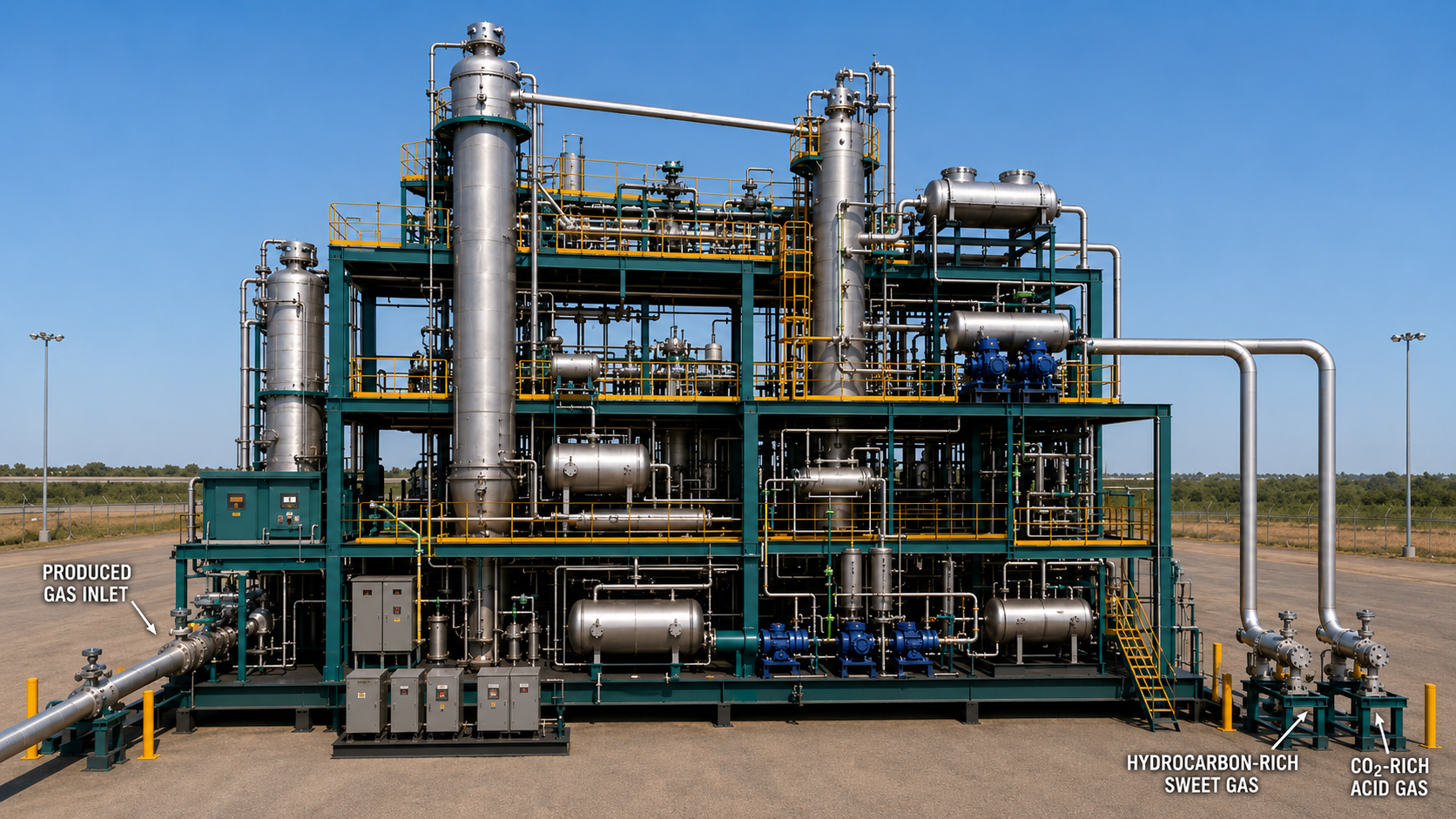
Produced fluids may contain dissolved natural gas, hydrogen, carbon dioxide, or other molecules that can be separated from the fluid stream. Recovery potential depends on composition, concentration, pressure, temperature, flow rate, processing requirements, infrastructure, market access, and the energy required to separate and condition the product.
Astero evaluates molecular recovery as part of the complete produced-fluid system rather than as an isolated processing opportunity.
Use representative fluid samples, pressure-volume-temperature data, gas analysis, dissolved-gas measurements, and production history to identify the molecules present in the produced stream.
Fluid Composition
Separation Technology
Evaluate separators, flash systems, membranes, adsorption, dehydration, compression, and conditioning technologies according to actual fluid composition and product specifications.
Determine whether recovered molecules can support onsite generation, field use, pipeline delivery, storage, industrial consumption, or another practical market pathway.
Product Handling
Calculate gross product value against separation energy, compression, conditioning, transportation, maintenance, and disposal requirements.
Net Energy Value
MINERAL + CRITICAL ELEMENT RECOVERY
Screen Produced Fluids for Mineral Value
Brine chemistry may support selective recovery where concentration and scale are sufficient
Produced fluids can contain dissolved minerals and elements, but the presence of an element does not establish commercial recoverability.
Astero evaluates concentration, total fluid throughput, competing ions, pretreatment requirements, recovery efficiency, waste generation, product purity, processing energy, equipment durability, reinjection compatibility, and market conditions.
The correct recovery method must be selected for the actual brine chemistry.
Resource Characterization
Measure the Complete Brine Chemistry
Evaluate adsorption, ion exchange, membranes, solvent extraction, precipitation, electrochemical systems, or other selective-recovery technologies according to actual fluid conditions.
Selective Recovery
Separate Without Disrupting Operations
Evaluate adsorption, ion exchange, membranes, solvent extraction, precipitation, electrochemical systems, or other selective-recovery technologies according to actual fluid conditions.
Product | Residual Management
Account for Every Output Stream
Define product concentration, purification, packaging, residual fluids, spent media, solids handling, water quality, chemical consumption, and reinjection compatibility before determining project value.
CARBON PATHWAYS
Evaluate Carbon Management as Infrastructure
Carbon-dioxide handling must be matched to the source, reservoir, monitoring plan, and commercial purpose
Astero may evaluate carbon-dioxide pathways where they complement a qualifying power, industrial, or resource project.
Potential pathways may include separation from project equipment, conditioning and compression, controlled use within an industrial process, infusion into a compatible produced-fluid system, transport to another facility, or injection into a suitable geologic formation.
The selected pathway must be supported by source characterization, reservoir analysis, containment evaluation, well integrity, monitoring, regulatory approval, operating responsibility, infrastructure, and long-term economics.
Astero may evaluate carbon-dioxide pathways where they complement a qualifying power, industrial, or resource project.
Potential pathways may include separation from project equipment, conditioning and compression, controlled use within an industrial process, infusion into a compatible produced-fluid system, transport to another facility, or injection into a suitable geologic formation.
The selected pathway must be supported by source characterization, reservoir analysis, containment evaluation, well integrity, monitoring, regulatory approval, operating responsibility, infrastructure, and long-term economics.
Product | Residual Management
Identify carbon-dioxide volume, pressure, purity, contaminants, variability, capture location, and the energy required for separation and conditioning.
Define the Carbon Stream
Conditioning | Compression
Identify carbon-dioxide volume, pressure, purity, contaminants, variability, capture location, and the energy required for separation and conditioning.
Prepare CO₂ for the Pathway
Reservoir Suitability
Assess geology, injectivity, capacity, containment, pressure behavior, legacy-well exposure, formation-fluid interactions, and operational compatibility.
Confirm Storage or Process Compatibility
Monitoring | Verification
Develop measurement, monitoring, verification, reporting, well-integrity, pressure-management, and closure requirements appropriate to the selected pathway.
Track Performance Over Time
WATER | PROCESS INTEGRATION
Preserve the Closed-Loop Fluid System
Recovery modules must support—not interrupt—power generation, water handling, and reinjection
Resource recovery should be integrated into the produced-fluid pathway without compromising plant availability, fluid compatibility, reservoir-pressure management, water quality, or reinjection continuity.
Astero evaluates each recovery module as part of the complete operating system, including bypass capability, redundancy, maintenance access, chemical addition, solids management, monitoring, off-spec diversion, and the final condition of the reinjected fluid.
Process Stages
Produce
Deliver fluid from production wells at the validated rate, pressure, temperature, and composition.
Convert
Recover thermal, hydraulic, and chemical energy through the primary Astero power pathway.
Process
Separate hydrocarbons, gas, solids, and other components required for operating continuity.
Recover
Apply only those molecular, mineral, water, or carbon modules supported by site-specific analysis.
Reinject
Condition the remaining fluid and return it through the designed injection system.
PROJECT-SPECIFIC SCREENING
Not Every Reservoir Supports Every Pathway
Commercial resource recovery requires more than detecting a molecule or element
A technically present resource may still be unsuitable for recovery.
Astero evaluates the complete pathway from reservoir and fluid chemistry through processing, infrastructure, permitting, operating cost, product quality, residual management, and market delivery.
A recovery concept should proceed only when the combined system can be designed responsibly and supported economically.
Fluid Chemistry
What Is Actually Present?
Utility yards, public works properties, water facilities, industrial development areas, and municipal land holdings.
Throughput
Is There Enough Continuous Flow?
Utility yards, public works properties, water facilities, industrial development areas, and municipal land holdings.
Technology Fit
Can the Resource Be Separated Reliably?
Match equipment and process chemistry to pressure, temperature, salinity, competing constituents, product specifications, and required recovery efficiency.
Infrastructure
Can the Product Be Handled?
Review power, roads, pads, pipelines, water systems, storage, transportation, interconnection, utilities, and downstream market access.
Regulation
Can the Pathway Be Permitted?
Evaluate environmental review, mineral ownership, pore-space rights, injection requirements, waste handling, monitoring, reporting, and operating responsibility.
Economics
Does the Net Value Justify Deployment?
Compare product value with capital cost, processing energy, consumables, maintenance, residual handling, transportation, permitting, and market risk.
PROJECT-SPECIFIC RESOURCE NOTICE
The presence of dissolved gases, minerals, critical elements, carbon-management potential, water-treatment opportunities, or other recoverable resources varies by reservoir and produced-fluid system. References on this page describe pathways that may be evaluated and do not represent confirmed resources, recoverable quantities, commercial reserves, storage capacity, or project economics for any specific site. Every pathway requires site-specific technical, regulatory, environmental, operational, and commercial validation.
MODULAR RECOVERY ARCHITECTURE
Add Recovery Capacity as Evidence Supports It
Astero can phase secondary processing around validated fluid volume and project economics
A project does not need to deploy every potential recovery system at initial startup.
Astero can evaluate a phased architecture in which power generation and essential fluid processing are established first, followed by controlled pilot recovery modules and later commercial expansion.
This approach allows the project to confirm performance before committing capital to full-scale recovery infrastructure.
Baseline Plant
Establish Power and Fluid Continuity
Deploy the power, processing, water-handling, and reinjection systems required for stable closed-loop operations.
Pilot Module
Test the Recovery Pathway
Install a controlled slipstream or pilot module to validate recovery rate, product quality, operating load, material performance, residual effects, and integration requirements.
Commercial Module
Scale With Verified Throughput
Expand processing capacity after concentration, uptime, recovery efficiency, equipment durability, residual management, and commercial delivery have been demonstrated.
Regional Platform
Aggregate Across Multiple Assets
Evaluate centralized processing only where multiple wells, fields, or facilities can provide sufficient volume, compatible chemistry, dependable infrastructure, and practical product delivery.
CLOSED-LOOP VALUE
Build More Value Into One Fluid System
Resource recovery may strengthen project economics without replacing the primary power objective
Where supported by reservoir conditions and commercial validation, additional recovery pathways may improve the productivity of the same produced-fluid system.
The objective is not to maximize equipment count. It is to identify the smallest practical combination of power, processing, recovery, water management, and reinjection systems that creates durable infrastructure value.
Additional Revenue
Create a saleable product or onsite resource from molecules, minerals, treated water, or carbon-management services.
Improved Project Utilization
Use the same wells, fluid throughput, roads, pads, utilities, and processing corridor to support multiple validated value pathways.
Better Water Management
Integrate filtration, conditioning, selective recovery, residual management, and reinjection into a disciplined produced-fluid strategy.
Phased Capital Deployment
Validate secondary pathways through sampling, pilot testing, modular installation, and operating data before committing full-scale capital.
Long-Term Infrastructure Value
Larger-scale deployment across public land, utility corridors, water systems, wells, industrial districts, and regional load centers.
Evaluate What Your Fluid System Can Support
Astero evaluates power generation first, then determines whether produced-fluid chemistry, reservoir conditions, infrastructure, processing technology, water-management requirements, regulation, and market access may support additional molecular, mineral, water, or carbon pathways.
The correct opportunity begins with site-specific evidence—not a generalized assumption about what every reservoir contains.
Preliminary Site Evaluation Information